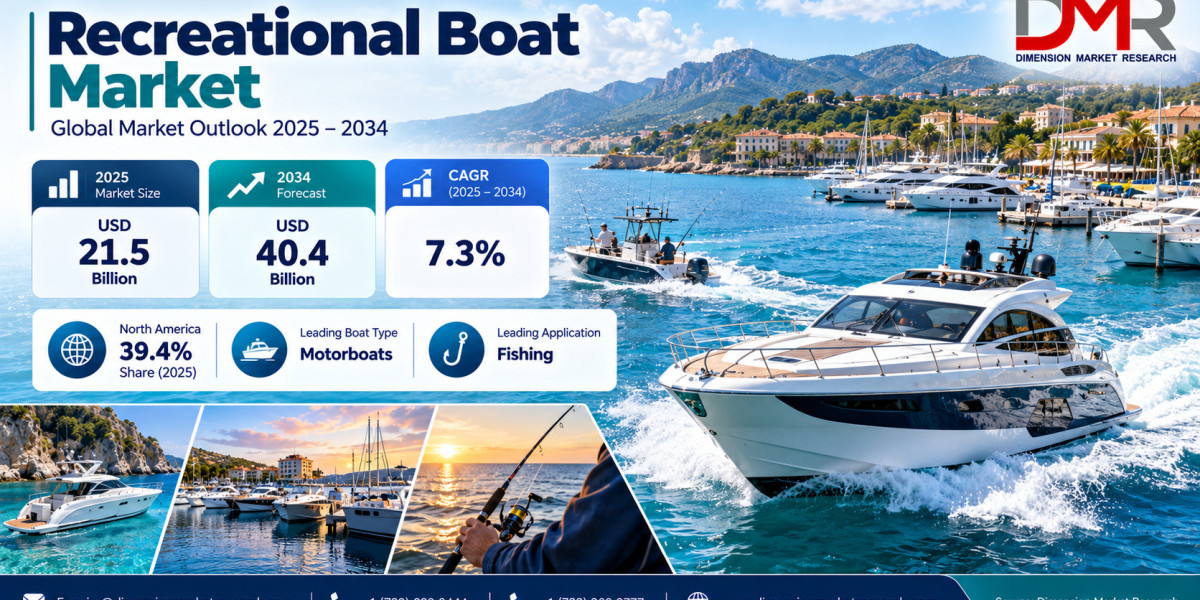

The global Recreational Boat Market is experiencing significant transformation as marine tourism, outdoor recreation, and technological innovation reshape consumer boating preferences. According to Dimension Market Research, the market is projected to reach USD 21.5 billion in 2025 and expand to USD 40.4 billion by 2034, growing at a CAGR of 7.3%.
Increasing disposable incomes, growing participation in water-based leisure activities, and expanding marina infrastructure are supporting demand for motorboats, yachts, sailboats, and personal watercraft. Consumers are increasingly exploring recreational boating for fishing, family vacations, watersports, and coastal tourism.
Advancements in electric propulsion, GPS navigation, automated docking, and connected marine technologies are creating opportunities for boat manufacturers, dealerships, charter operators, and marine equipment suppliers.
What Is the Recreational Boat Market?
The Recreational Boat Market includes vessels designed primarily for leisure, fishing, watersports, cruising, and tourism rather than commercial transportation.
Major categories include motorboats, sailboats, yachts, and inflatable boats. These vessels are available in different sizes, materials, propulsion systems, and configurations.
The industry also includes boat ownership, rental and charter services, fractional ownership, and boat clubs.
Market demand is closely connected to tourism infrastructure, consumer spending, marine recreation participation, and advancements in boat manufacturing.
Recreational Boat Market Size and Key Statistics
The DMR report highlights the following indicators:
● 2025 Market Size: USD 21.5 Billion
● 2034 Market Forecast: USD 40.4 Billion
● Forecast CAGR: 7.3%
● North America Market Share: 39.4%
● US Market Size: USD 7.1 Billion in 2025
● Leading Boat Type: Motorboats
● Leading Power Source: Engine-Powered Boats
● Leading Application: Fishing
● Leading Ownership Category: Personal/Recreational Use
● Leading Sales Channel: Dealership Sales
These findings highlight the importance of accessible motorboats, established boating communities, and specialized marine retail networks.
Why Is the Recreational Boat Market Growing?
Rising Participation in Marine Leisure Activities
Recreational boating is increasingly associated with outdoor lifestyles, adventure tourism, and family entertainment.
Fishing, coastal cruising, wakeboarding, and watersports are encouraging demand for versatile vessels.
Consumers in established boating markets are investing in watercraft that combine convenience, comfort, and recreational functionality.
Meanwhile, growing middle-income populations in emerging economies are creating opportunities for entry-level motorboats and personal watercraft.
Expansion of Boat Rentals and Shared Ownership
High purchase prices and maintenance costs remain barriers to individual ownership.
Boat-sharing platforms, rental services, and fractional ownership models provide alternatives for consumers seeking occasional access.
Digital reservation platforms improve vessel discovery, booking convenience, and payment processing.
These models also create opportunities for manufacturers supplying boats to rental fleets and charter operators.
Get a Free Sample of the Recreational Boat Market Report
Explore detailed market forecasts, vessel segmentation, propulsion technologies, regional demand, competitive intelligence, and emerging marine recreation opportunities through the Dimension Market Research study.
https://dimensionmarketresearch.com/request-sample/recreational-boat-market/
How Electric Propulsion and Smart Technology Are Transforming Recreational Boats
Technology innovation is changing how recreational vessels are designed, operated, and maintained.
Electric and hybrid propulsion systems are attracting interest from consumers seeking quieter operation and lower direct emissions.
GPS navigation, connected dashboards, and digital monitoring systems are improving access to information about vessel performance.
Important developments include:
● Electric and hybrid marine propulsion
● GPS-enabled smart navigation systems
● AI-supported predictive maintenance
● Automated docking and vessel monitoring
Manufacturers are also exploring lightweight composites, modular interiors, and energy-efficient hull designs.
These innovations support greater customization and may improve operating efficiency, depending on vessel type and usage conditions.
Recreational Boat Market Segmentation Analysis
Motorboats Lead Boat Type Demand
Motorboats represent the leading boat type because of their versatility across fishing, cruising, watersports, and recreational transportation.
Their maneuverability and availability across different price categories appeal to both experienced boaters and first-time buyers.
Yachts cater to premium tourism and luxury experiences, while inflatable boats provide flexibility for selected leisure activities.
Engine-Powered Boats Maintain Leadership
Engine-powered vessels dominate the power source category because of their speed, operating flexibility, and suitability for multiple recreational applications.
Gasoline and diesel engines remain established technologies.
Electric and hybrid alternatives are gaining attention as battery systems and marine charging infrastructure develop.
Fishing Dominates Recreational Applications
Fishing represents the leading application, supported by participation in freshwater and coastal angling.
Specialized fishing vessels incorporate features such as rod storage, GPS plotters, fish finders, and live wells.
Cruising, watersports, and tourism provide additional demand across different boat categories.
Personal Ownership and Dealership Sales Lead
Personal and recreational ownership remains the dominant ownership model.
Consumers value the convenience of having access to their own vessels for regular leisure activities.
Dealership sales lead distribution because buyers often require product demonstrations, financing, technical support, and maintenance services.
Regional Outlook: North America Leads the Recreational Boat Market
North America is projected to account for approximately 39.4% of global market revenue in 2025.
The region benefits from extensive coastlines, inland waterways, established marinas, and a strong recreational boating culture.
The United States market is projected to increase from USD 7.1 billion in 2025 to USD 12.9 billion by 2034.
Europe represents another important market, valued at approximately USD 3.2 billion in 2025, with expected growth to USD 5.9 billion by 2034.
Mediterranean tourism, yacht charter activities, and recreational boating infrastructure support regional demand.
Japan's market is projected to reach USD 1.2 billion in 2025 and USD 2.2 billion by 2034.
Asia-Pacific and Latin America offer opportunities through expanding coastal tourism, marina investment, and increasing participation in outdoor recreation.
Competitive Landscape and Leading Companies
The Recreational Boat Market includes international boat manufacturers, specialized vessel builders, and marine equipment providers.
Prominent companies identified by DMR include Brunswick Corporation, Groupe Beneteau, Yamaha Motor, Malibu Boats, Ferretti Group, Azimut-Benetti Group, Sunseeker International, Princess Yachts, HanseYachts, and MasterCraft Boat Holdings.
Competition centers on product innovation, vessel performance, pricing, customization, dealership networks, and after-sales support.
Manufacturers are introducing connected technologies, improved propulsion systems, and versatile vessel designs to address changing consumer preferences.
Challenges and Future Growth Opportunities
High ownership costs, insurance expenses, fuel prices, maintenance requirements, and limited marina capacity can restrict market accessibility.
Environmental regulations and seasonal demand fluctuations also influence purchasing decisions.
However, electric boats, smart navigation, expanding tourism infrastructure, and shared ownership models create opportunities.
Manufacturers offering reliable, efficient, and customizable vessels may strengthen their competitive positions.
Explore the Complete Recreational Boat Market Analysis
Access comprehensive market forecasts, boat type segmentation, regional opportunities, competitive profiles, and strategic marine industry insights through the complete Dimension Market Research report.
https://dimensionmarketresearch.com/checkout/recreational-boat-market/
Frequently Asked Questions
1. What is the Recreational Boat Market size?
The global Recreational Boat Market is projected to reach USD 21.5 billion in 2025 and USD 40.4 billion by 2034.
2. What is the CAGR of the Recreational Boat Market?
The market is expected to grow at a CAGR of 7.3% from 2025 to 2034.
3. Which boat type dominates the Recreational Boat Market?
Motorboats lead because of their widespread use in fishing, cruising, and watersports.
4. Which region leads the Recreational Boat Market?
North America leads with approximately 39.4% market share in 2025.
5. What are the major future growth opportunities?
Electric propulsion, smart boating technologies, yacht tourism, boat-sharing platforms, and emerging marina infrastructure represent important opportunities.
Conclusion
The Recreational Boat Market is positioned for steady expansion as outdoor recreation, marine tourism, and technological innovation influence consumer spending.
Motorboats, engine-powered vessels, and recreational fishing remain important contributors to market demand.
Electric propulsion, digital navigation, and flexible ownership models are creating new opportunities for manufacturers and service providers.
Companies combining reliable vessel performance, advanced features, and accessible boating experiences are positioned to benefit from changing marine leisure preferences through 2034.
Related Marine Recreation and Outdoor Leisure Market Insights
The Boat Rental Market Size is projected to increase from USD 23.3 billion in 2026 to USD 38.4 billion by 2035, growing at a CAGR of 5.7%. Rising demand for marine tourism, peer-to-peer boat sharing, and digital charter platforms is expanding access to recreational boating without requiring vessel ownership.
The Recreational Fishing Equipment Market Share analysis projects growth from USD 14.8 billion in 2025 to USD 24.4 billion by 2034, at a CAGR of 5.7%. Increasing participation in angling, smart fishing technologies, and demand for environmentally responsible equipment are supporting industry development.
The PowerSports Market Growth study forecasts expansion from USD 34.8 billion in 2025 to USD 64.2 billion by 2034, growing at a CAGR of 7.1%. Rising interest in adventure recreation, personal watercraft, off-road vehicles, and performance motorcycles is encouraging investment in recreational mobility technologies.