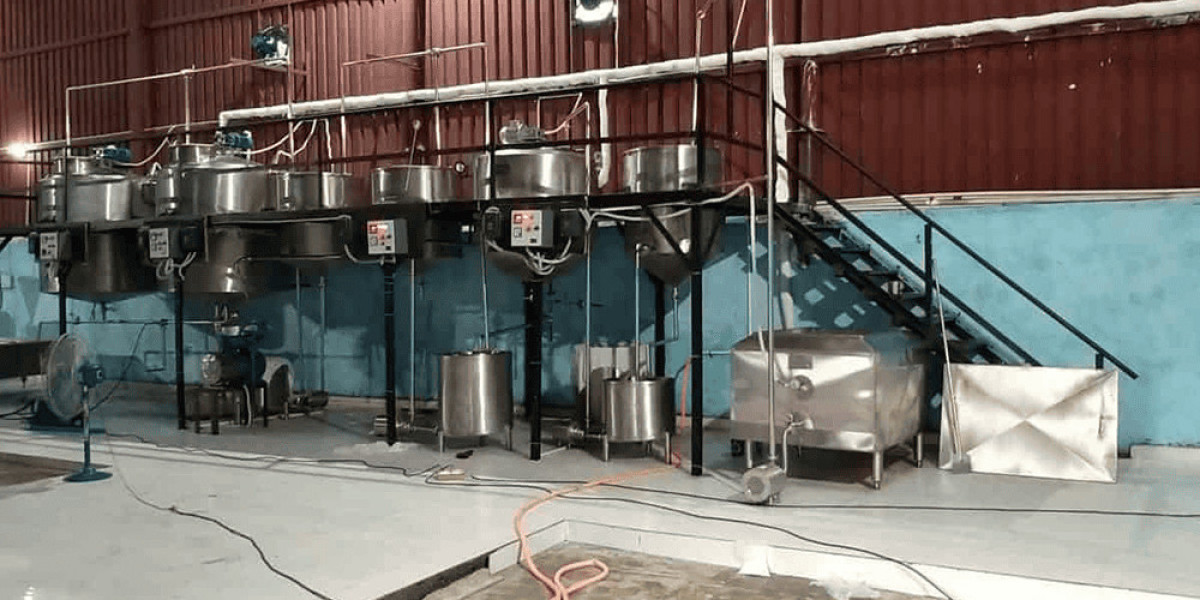

Setting up a commercial ghee manufacturing facility involves decisions about process technology, equipment, factory layout, utilities, hygiene, packaging, and quality management. A properly planned Ghee Plant can provide a controlled production environment while allowing businesses to adapt output and packaging as demand changes.
Define the Business Requirement First
Before ordering machinery, establish the basic project parameters:
- Target daily production
- Raw-material source
- Processing method
- Number of operating shifts
- Packaging sizes
- Storage requirements
- Automation level
- Available factory space
- Utility availability
- Target countries
These factors provide the foundation for selecting the appropriate equipment configuration.
Production Flow
A typical commercial production route is:
Receiving → Storage → Melting/Preparation → Heating → Clarification → Filtration → Finished Product Storage → Filling → Sealing → Dispatch
Each stage should have adequate capacity so that one operation does not slow down the complete production line.
Equipment and Its Role
Storage Tanks
Storage tanks hold raw material and finished product under controlled conditions.
Heating Equipment
Heated vessels provide the thermal treatment required during ghee production.
Clarification System
Clarification separates non-fat components from the dairy fat during processing.
Filtration Equipment
Filters remove remaining suspended particles before the finished product enters storage or packaging.
Pumps and Pipelines
Sanitary transfer equipment moves product between processing stages.
Filling and Sealing
Packaging machinery provides measured filling and secure closure for the finished product.
Cleaning System
Cleaning equipment or CIP arrangements support routine sanitation of product-contact systems.
Factory Infrastructure
A processing facility requires more than production machinery. Utilities and building infrastructure should be planned together.
Depending on the selected system, the project may require:
- Electrical power
- Steam or another heating source
- Water
- Drainage
- Ventilation
- Compressed air
- Cleaning facilities
- Finished-goods storage
Utility capacity should be calculated for the complete line, including future expansion where practical.
Quality and Traceability
Quality management should begin with raw materials and continue through packaging.
A manufacturer can establish controls for incoming materials, processing conditions, filtration, storage, filling, and final product inspection.
Traceability systems can record batch information, production dates, raw-material sources, packaging lots, and dispatch details.
Choosing a Packaging Format
Packaging depends on the customer and market.
Retail businesses may need smaller packs and multiple container sizes. Food-service businesses may prefer larger containers. Industrial customers may require bulk formats.
The filling machine should therefore be selected only after the intended container type, fill volume, and production speed have been defined.
USA
For the US market, applicable FDA food-safety requirements should be reviewed during facility planning. Covered businesses may need hazard analysis and risk-based preventive controls, along with monitoring and records.
This makes process documentation and sanitation planning important parts of the project.
UK
A UK-oriented facility should consider food hygiene, food information, allergen communication, packaging, and labelling. The final packaging system should allow the required product information to be presented clearly.
Australia
Australia uses the Australia New Zealand Food Standards Code. FSANZ states that food sold in Australia and New Zealand must comply with applicable food standards, while specific requirements vary according to the product and situation.
Businesses should therefore review the exact product requirements before finalising packaging and labels.
New Zealand
For New Zealand, dairy processing and export requirements should be incorporated into project planning. MPI explains that export dairy products must comply with New Zealand requirements as well as destination-country rules, and applicable products must operate under the required food-safety programme.
Export-oriented businesses should therefore consider traceability and documentation from the beginning.
UAE
A UAE-focused facility should consider applicable product registration, import, labelling, and packaging requirements. Storage and transportation conditions are also important, particularly when products may experience high ambient temperatures.
South Africa
South African businesses should verify the requirements applicable to their specific ghee product and distribution model. The facility should provide hygienic processing, controlled storage, suitable packaging, and traceability.
Canada
Canadian businesses should review the applicable dairy, food-safety, preventive-control, composition, and labelling requirements. Product documentation should be maintained through manufacturing and distribution.

Selecting the Right Automation Level
Automation can be used selectively. Temperature monitoring, heating control, tank levels, product transfer, filling, and alarms can all be automated depending on the project.
For a smaller facility, partial automation may provide a practical balance. Larger operations may benefit from integrated process controls and production records.
Future Expansion
A business should not only plan for today’s production. If demand is expected to increase, the factory should allow space for additional tanks, packaging equipment, utilities, or processing capacity.
Planning expansion routes during the initial design can reduce disruption later.
FAQs
1. How should a business begin planning a Ghee Plant?
Start with the product, production capacity, raw material, process method, packaging, target markets, utilities, factory space, and required automation.
2. What are the most important equipment groups?
Processing vessels, heating systems, clarification and filtration equipment, storage tanks, pumps, sanitary pipelines, packaging machinery, cleaning systems, and process controls are common equipment groups.
3. Is a large processing capacity always better?
No. Capacity should match raw-material availability, demand, operating hours, storage, and packaging capabilities. Oversized equipment may not be efficiently utilised.
4. Why should export markets be considered during plant design?
Destination requirements can affect product specifications, packaging, labelling, testing, documentation, and traceability. Early planning helps reduce the need for later modifications.
Conclusion
A modern Ghee Plant should be viewed as a complete manufacturing system rather than a single piece of machinery. Processing, utilities, hygiene, quality management, packaging, automation, storage, and market requirements all need to work together.
NK Dairy Equipments LLP is an India-based manufacturer and exporter of dairy processing equipment, supplying dairy processing solutions to international markets including the USA and other global destinations.
Learn More About Ghee Processing Solutions:
Explore Ghee Plant solutions, equipment options, process flow, and commercial setup requirements with NK Dairy Equipments LLP.
Visit: https://nkdairyequipments.com/ghee-plant/