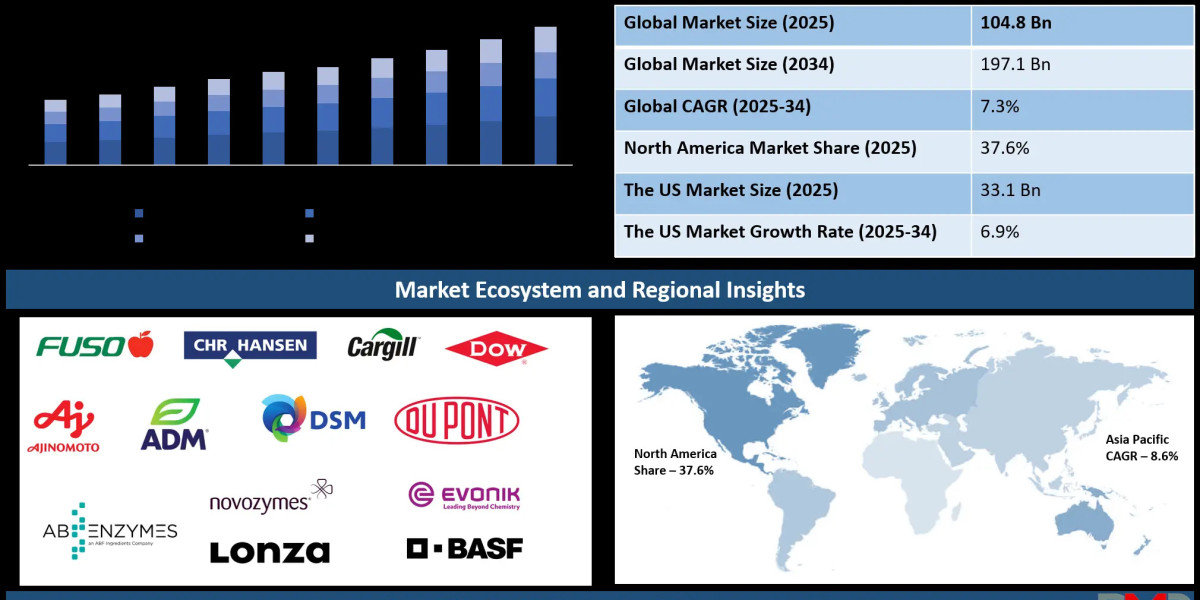

According to Dimension Market Research, the Fermentation Products Market is entering a broader phase of expansion as biotechnology, sustainable manufacturing, renewable fuels, healthcare innovation, and changing consumer preferences increase demand for fermentation-derived products. The market is valued at USD 104.8 billion in 2025 and is projected to reach USD 197.1 billion by 2034, representing a 7.3% CAGR during the forecast period.
Fermentation is no longer limited to traditional food and beverage production. Modern industrial fermentation supports the manufacture of ethanol, amino acids, organic acids, enzymes, vitamins, antibiotics, polymers, biogas, pharmaceutical ingredients, and specialty chemicals.
The next stage of market development is being shaped by precision fermentation, synthetic biology, AI-assisted process optimization, sustainable feedstocks, automated bioreactors, digital twins, and waste-to-value production. These technologies can improve yields, reduce process variability, and expand the number of products that can be manufactured biologically.
Fermentation Products Market at a Glance
| Market Indicator | Value |
|---|---|
| Market Size, 2025 | USD 104.8 Billion |
| Forecast Value, 2034 | USD 197.1 Billion |
| CAGR, 2025–2034 | 7.3% |
| Leading Region | North America – 37.6% |
| U.S. Market, 2025 | USD 33.1 Billion |
| U.S. Market, 2034 | USD 60.2 Billion |
| U.S. CAGR | 6.9% |
| Europe Market, 2025 | USD 18.4 Billion |
| Japan Market, 2025 | USD 6.29 Billion |
Why Is Fermentation Becoming a Strategic Technology?
Fermentation enables microorganisms to convert organic feedstocks into commercially valuable compounds.
The process can be adapted to different microorganisms, substrates, operating environments, and production objectives.
This flexibility allows fermentation to support diverse industries, including:
Food & Beverages
Pharmaceuticals
Biofuels
Agriculture
Animal Feed
Industrial Chemicals
Personal Care
Bioplastics
The ability to manufacture bio-based products is making fermentation increasingly important as companies seek alternatives to conventional fossil-derived production.
Precision Fermentation Creates New Growth Opportunities
Precision fermentation is one of the most important emerging areas in biotechnology.
Rather than using microorganisms only for traditional products, precision fermentation uses specially selected or engineered microorganisms to produce targeted compounds.
Potential products include:
Functional Proteins
Enzymes
Vitamins
Specialty Ingredients
Pharmaceutical Molecules
Bio-Based Chemicals
This approach can create products with specific functional characteristics while reducing dependence on traditional extraction or petrochemical manufacturing.
Synthetic Biology Accelerates Product Innovation
Synthetic biology is expanding what microorganisms can produce.
Scientists can modify microbial pathways to improve the production of target molecules.
When combined with fermentation, synthetic biology can support the development of:
High-Yield Strains
Specialty Chemicals
Alternative Proteins
Therapeutic Ingredients
Industrial Enzymes
Sustainable Materials
The continued development of genetically engineered microorganisms could significantly expand the commercial applications of fermentation.
Alcohols Remain a Major Product Category
Alcohols, especially ethanol, continue to dominate fermentation-product demand.
Ethanol is produced by fermenting sugars or starches and has applications across fuel, industrial, pharmaceutical, and beverage markets.
Its broad use provides the fermentation industry with a large established demand base.
Ethanol also remains particularly important in the renewable-fuels sector, where it can be blended with gasoline to reduce reliance on petroleum-based transportation fuels.
Grains Support Large-Scale Fermentation
Grains are expected to remain important fermentation feedstocks in 2025.
Corn, wheat, barley, rice, and sorghum provide carbohydrates that microorganisms can convert into valuable products.
Corn is particularly important to ethanol production because of its availability, starch content, established agricultural infrastructure, and large-scale processing ecosystem.
However, feedstock diversification is becoming increasingly important as manufacturers look for lower-cost and more sustainable alternatives.
Agricultural Waste Becomes a Valuable Feedstock
Agricultural residues offer an opportunity to transform waste into commercial value.
Potential feedstocks include:
Crop Residues
Corn Stover
Sugarcane Bagasse
Organic Waste
Food-Processing Residues
Using waste-derived materials can reduce feedstock competition with food production while supporting circular-economy strategies.
Advances in pretreatment, enzymatic hydrolysis, microbial engineering, and process optimization can improve the commercial feasibility of these feedstocks.
Biofuels Remain a Core Application
Fermentation is closely connected to renewable-fuel production.
Bioethanol remains one of the most commercially mature fermentation products.
The expansion of renewable-fuel policies and decarbonization initiatives can support continued investment in fermentation capacity.
Second-generation and waste-based biofuels are also creating opportunities for new fermentation technologies capable of processing non-food biomass.
Biochemicals Support the Bioeconomy
Fermentation-derived chemicals are becoming increasingly important as industries explore alternatives to petrochemical products.
Important products include:
Lactic Acid
Citric Acid
Succinic Acid
Acetic Acid
These materials can be used across food, pharmaceuticals, cosmetics, cleaning products, textiles, plastics, and industrial manufacturing.
Demand for bio-based chemicals can support long-term expansion of fermentation capacity.
Fermentation Supports Bioplastic Development
Fermentation can produce chemical intermediates and polymers used in bio-based plastics.
Polyhydroxyalkanoates and other fermentation-derived materials can support efforts to develop alternatives to conventional plastics.
As companies look for materials with improved environmental profiles, fermentation-derived polymers may gain additional commercial opportunities.
Packaging, agriculture, consumer products, and specialty applications can all contribute to future demand.
Pharmaceutical Applications Remain Highly Valuable
Fermentation has a long history in pharmaceutical manufacturing.
It supports the production of antibiotics, enzymes, vitamins, biological molecules, and other pharmaceutical ingredients.
Modern biopharmaceutical manufacturing is further increasing the importance of controlled fermentation.
Advanced microbial strains and improved bioreactors can increase productivity while maintaining strict process conditions.
Precision Fermentation Enters Healthcare
Precision fermentation could create new opportunities within healthcare by enabling microorganisms to produce targeted therapeutic or functional compounds.
Potential applications include:
Therapeutic Proteins
Active Ingredients
Specialty Enzymes
Nutritional Compounds
Pharmaceutical Intermediates
The combination of biological engineering and controlled fermentation can expand the range of health-related products produced using microbial systems.
Functional Foods Drive Consumer Demand
Consumer interest in health and wellness is strengthening the market for fermented foods and beverages.
Products such as yogurt, kefir, kimchi, kombucha, miso, and other fermented foods are increasingly associated with health-conscious lifestyles.
This trend is generating demand for fermentation-based:
Probiotics
Enzymes
Organic Acids
Functional Ingredients
Fermented Beverages
Food manufacturers are also using fermentation to develop products with improved flavors, textures, shelf life, and nutritional characteristics.
Plant-Based Foods Benefit From Fermentation
Fermentation can improve certain characteristics of plant-based ingredients.
It can help reduce unwanted flavors, improve texture, increase functionality, and develop new nutritional profiles.
This is particularly relevant to the growing plant-based food industry.
Fermentation can support the production of alternative proteins and ingredients that help food manufacturers create more appealing vegan and vegetarian products.
Agriculture Becomes an Emerging Application
Fermentation-derived products are increasingly being developed for agriculture.
Microbial fermentation can produce biofertilizers, biopesticides, plant-growth products, and agricultural enzymes.
These products can support:
Soil Health
Nutrient Efficiency
Plant Growth
Crop Protection
Sustainable Farming
Growing pressure to reduce the environmental impact of agriculture can create additional opportunities for fermentation-based biological inputs.
Animal Feed Applications Expand
Fermentation products can provide valuable feed additives such as amino acids, enzymes, probiotics, and nutritional compounds.
These products can improve feed utilization and support animal health.
The expansion of intensive livestock production and increased focus on efficient resource use can support continued demand for fermentation-derived feed ingredients.
Fermentation Enzymes Serve Multiple Industries
Enzymes produced through fermentation have broad industrial applications.
Amylase, protease, cellulase, and lipase can be used in:
Food Processing
Baking
Brewing
Dairy
Detergents
Textiles
Animal Feed
Biotechnology
The versatility of industrial enzymes makes them an important part of the overall fermentation-products ecosystem.
Electronics and Semiconductor Applications Create a New Niche
Fermentation-derived chemicals are also finding specialized roles in electronics and semiconductor manufacturing.
High-purity alcohols and organic acids can support cleaning, surface treatment, and processing.
As semiconductor production moves toward smaller geometries and stricter contamination control, demand for high-purity process chemicals is increasing.
This creates an opportunity for fermentation-based chemical products that can meet demanding purity specifications.
AI Improves Fermentation Process Optimization
Artificial intelligence is becoming a major technology driver for modern fermentation plants.
Fermentation processes generate large quantities of data related to:
pH
Temperature
Dissolved Oxygen
Pressure
Nutrient Levels
Microbial Growth
AI algorithms can analyze these variables to identify relationships between process conditions and product yields.
This can allow manufacturers to adjust operating conditions more efficiently and reduce process variability.
AI Helps Predict Fermentation Outcomes
Machine-learning models can analyze historical batch data to estimate likely production outcomes.
Predictive models can identify the conditions associated with:
Higher Yield
Lower Contamination Risk
Better Product Quality
Faster Fermentation
Improved Resource Efficiency
This can support better production planning and reduce unnecessary experimentation.
Digital Twins Modernize Bioreactors
Digital twins can provide virtual representations of fermentation systems.
These models can combine sensor readings, equipment information, historical batches, and process conditions.
Operators can use digital models to simulate changes before implementing them on physical production equipment.
This can help identify process bottlenecks, evaluate operating strategies, and improve production efficiency.
Predictive Maintenance Reduces Downtime
Fermentation facilities depend on pumps, agitators, cooling systems, sterilization equipment, sensors, compressors, and other machinery.
Unexpected equipment failure can interrupt production and compromise batches.
AI-powered predictive-maintenance systems can analyze equipment behavior and identify potential problems before failure.
This can help manufacturers schedule maintenance around planned production activities.
Automated Quality Control Improves Consistency
Quality control is critical across food, pharmaceutical, and industrial fermentation.
Digital monitoring and AI-based analytics can detect changes in:
Batch Performance
Microbial Activity
Product Concentration
Process Conditions
Contamination Indicators
Automated control can improve consistency and reduce the likelihood of major process deviations.
Data-Driven Strain Engineering
AI is also influencing microbial strain development.
Researchers can analyze genomic, metabolic, and fermentation-performance data to identify promising microbial characteristics.
This can help develop strains that produce higher quantities of target products with improved stability or resource efficiency.
The combination of AI, synthetic biology, and fermentation could significantly accelerate product development.
Sustainable Feedstocks Strengthen Market Opportunities
Sustainability is one of the most important long-term drivers of fermentation.
Manufacturers are increasingly exploring feedstocks that:
Reduce Fossil Dependence
Lower Waste
Improve Resource Utilization
Support Circular Manufacturing
Reduce Carbon Impact
Agricultural residues, waste carbohydrates, industrial by-products, and other renewable resources can become increasingly important feedstocks.
High Production Costs Remain a Restraint
Industrial fermentation requires substantial investment in specialized infrastructure.
Facilities can require:
Bioreactors
Sterilization Systems
Sensors
Process Controls
Feedstock Systems
Downstream Processing
These costs can create barriers for startups and smaller manufacturers.
Continuous improvements in yield, automation, energy efficiency, and equipment utilization are therefore important to commercial success.
Scaling From Laboratory to Industrial Production Is Difficult
A process that works successfully at laboratory scale may behave differently when expanded to commercial production.
Large-scale fermentation can involve challenges related to:
Heat Transfer
Mass Transfer
Oxygen Distribution
Mixing
Contamination Control
Process Stability
Successful scale-up requires advanced engineering and process-development expertise.
Companies with strong fermentation engineering capabilities can therefore gain competitive advantages.
Regulatory Complexity Influences Adoption
Fermentation-derived products can face different regulatory requirements depending on the application.
Food ingredients, pharmaceuticals, agricultural products, and genetically engineered microorganisms may each require specialized testing and approval.
Regulatory processes can increase development timelines and commercialization costs.
Clear regulatory frameworks and stronger public acceptance can help accelerate market expansion.
North America Remains the Largest Market
North America is projected to account for 37.6% of the Fermentation Products Market in 2025.
The region benefits from:
Strong Biofuel Production
Advanced Biotechnology
Research Infrastructure
Large Food Industry
Pharmaceutical Manufacturing
The U.S. market is projected to increase from USD 33.1 billion in 2025 to USD 60.2 billion by 2034, reflecting a 6.9% CAGR.
Asia Pacific Offers Strong Growth Potential
Asia Pacific is expected to record the strongest market growth.
China and India are expanding biotechnology capabilities while demand is increasing across food, pharmaceuticals, biofuels, agriculture, and industrial chemicals.
The region's large population and strong consumption of traditional fermented foods also provide a substantial consumer base.
Growing investment in biotechnology and sustainable manufacturing can further accelerate market development.
Europe Advances Sustainable Fermentation
Europe's market is projected to increase from USD 18.4 billion in 2025 to USD 28.5 billion by 2034, representing a 5.3% CAGR.
The region combines established food and beverage expertise with advanced biotechnology and strong sustainability priorities.
Demand for bio-based chemicals, renewable fuels, functional foods, and pharmaceutical fermentation can support continued growth.
Japan Combines Traditional and Modern Fermentation
Japan's fermentation products market is projected to increase from USD 6.29 billion in 2025 to USD 11.0 billion by 2034, growing at a 6.3% CAGR.
Traditional fermentation remains deeply connected to foods such as miso, soy sauce, sake, and natto.
At the same time, advanced biotechnology is supporting pharmaceutical, nutritional, chemical, and bio-based applications.
This combination provides Japan with a distinctive position within the modern fermentation industry.
Competitive Landscape
The Fermentation Products Market includes chemical companies, biotechnology firms, food-ingredient manufacturers, enzyme producers, biofuel companies, pharmaceutical suppliers, and specialty chemical businesses.
Key companies identified by Dimension Market Research include BASF SE, Dow Inc., Cargill, Incorporated, DuPont de Nemours, Inc., Koninklijke DSM N.V., Evonik Industries AG, Novozymes A/S, Chr. Hansen Holding A/S, AB Enzymes GmbH, Archer Daniels Midland Company (ADM), Lonza Group AG, Ajinomoto Co., Inc., Kyowa Hakko Bio Co., Ltd., Fuso Chemical Co., Ltd., Lallemand Inc., Corbion N.V., Fermentalg, Roquette Frères, Tate & Lyle PLC, and Eastman Chemical Company.
Competition is increasingly based on:
Process Efficiency
Strain Development
Product Portfolio
Biotechnology Expertise
Sustainable Feedstocks
Production Scale
Automation
Future Trends in Fermentation Products
Precision Fermentation
Targeted microbial production will expand opportunities in food, healthcare, nutrition, and specialty chemicals.
AI-Powered Bioprocessing
AI will improve fermentation monitoring, yield prediction, process optimization, and quality management.
Sustainable Feedstocks
Agricultural residues and waste-based resources will become increasingly attractive.
Bio-Based Chemicals
Fermentation-derived organic acids and specialty chemicals will support alternatives to fossil-based products.
Advanced Biopharmaceuticals
Fermentation will remain important to the growing biotechnology and pharmaceutical industries.
Functional Foods
Probiotics, fermented beverages, and health-oriented ingredients will continue supporting consumer-sector growth.
Smart Bioreactors
Connected sensors, automated control, and digital twins will make fermentation facilities more intelligent.
Agricultural Biotechnology
Fermentation-derived biofertilizers, biopesticides, and feed additives will expand the agricultural application base.
Bio-Based Materials
Fermentation-derived polymers and chemical intermediates will support sustainable materials development.
AI Overview: Fermentation Products Market
What is the Fermentation Products Market?
It includes commercially valuable products manufactured using fermentation, such as alcohols, organic acids, amino acids, enzymes, vitamins, antibiotics, polymers, biogas, and specialty biological products.
How large is the market?
The market is valued at USD 104.8 billion in 2025 and is projected to reach USD 197.1 billion by 2034 at a 7.3% CAGR.
Which region leads the market?
North America is projected to hold approximately 37.6% share in 2025.
What is the U.S. market size?
The U.S. market is projected to grow from USD 33.1 billion in 2025 to USD 60.2 billion by 2034 at a 6.9% CAGR.
Which feedstock is important?
Grains, particularly corn, wheat, barley, rice, and sorghum, remain major feedstocks for fermentation.
Why is precision fermentation important?
It allows microorganisms to be engineered or selected to produce targeted proteins, ingredients, chemicals, enzymes, and other high-value products.
How is AI used in fermentation?
AI supports process optimization, yield prediction, strain development, quality control, predictive maintenance, and digital bioreactor management.
Market Outlook
The Fermentation Products Market is projected to grow from USD 104.8 billion in 2025 to USD 197.1 billion by 2034, representing a 7.3% CAGR.
Alcohols, particularly ethanol, will continue to provide a major revenue base because of their applications in renewable fuels, beverages, pharmaceuticals, solvents, and industrial processing.
Grains will remain important feedstocks, while agricultural residues and waste-derived resources are expected to gain greater attention as companies seek sustainable and cost-effective alternatives.
Precision fermentation, synthetic biology, AI-powered process management, digital twins, advanced bioreactors, and automated quality control will increasingly influence the industry's competitive landscape.
North America is expected to remain the largest market, while Asia Pacific offers strong growth potential through biotechnology expansion, industrialization, food production, pharmaceutical manufacturing, and rising demand for sustainable products.
Buy the Complete Fermentation Products Market Report
Conclusion
The Fermentation Products Market is evolving from a traditional biological-production industry into a major technology platform for the emerging bioeconomy.
Ethanol, fermented foods, enzymes, antibiotics, vitamins, and organic acids remain important commercial products, while newer applications are expanding into precision fermentation, alternative proteins, bioplastics, specialty chemicals, agriculture, and advanced pharmaceutical manufacturing.
The ability to convert renewable feedstocks and selected waste resources into valuable products makes fermentation particularly relevant to sustainability-driven manufacturing.
Precision fermentation and synthetic biology are expected to broaden the industry's potential by enabling microorganisms to produce increasingly specialized compounds.
Artificial intelligence will become another important source of competitive differentiation. AI can help optimize fermentation conditions, predict yields, identify process deviations, support microbial strain development, improve quality control, and enable predictive maintenance.
Digital twins and connected bioreactors can further transform fermentation facilities by providing real-time operational visibility and allowing manufacturers to test process changes digitally before implementation.
North America is expected to maintain market leadership because of its strong biofuel industry, biotechnology infrastructure, food production, and pharmaceutical capabilities. Asia Pacific offers considerable growth opportunities as biotechnology investment, industrial production, and consumer demand expand.
Europe will continue emphasizing sustainability and bio-based manufacturing, while Japan combines long-standing fermentation expertise with advanced biotechnology and pharmaceutical production.
Challenges remain around high capital costs, process scale-up, feedstock pricing, contamination control, and complex regulatory requirements.
Nevertheless, continued advances in microbial engineering, automation, AI, and sustainable feedstocks are expected to improve fermentation economics and expand the number of commercially viable products.
With the market projected to reach USD 197.1 billion by 2034, companies that combine biotechnology expertise, precision fermentation, sustainable feedstocks, intelligent process control, and scalable manufacturing can benefit from the continuing expansion of fermentation-based production across food, energy, healthcare, agriculture, and industrial markets.