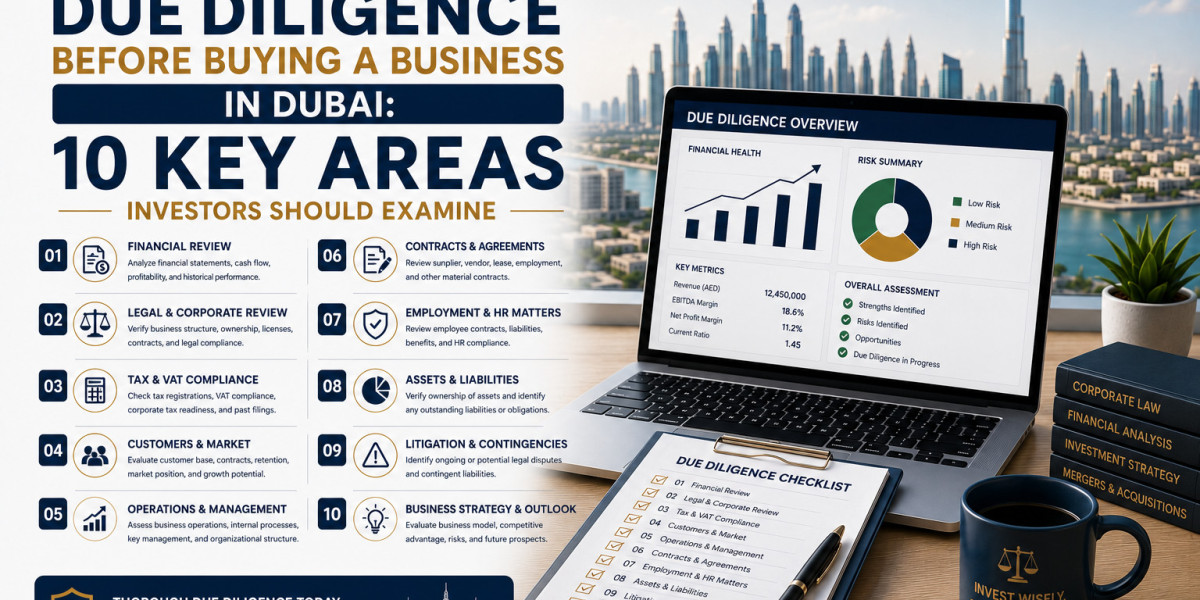

Buying an established business in Dubai can offer investors access to an existing customer base, operating structure, employees, suppliers, and revenue streams. However, purchasing an existing company also means taking on its existing financial, commercial, operational, and legal circumstances.
A business may look attractive on paper while carrying outstanding liabilities, weak customer relationships, contractual restrictions, compliance issues, or operational weaknesses.
This is why conducting due diligence before buying a business in Dubai is an important step before committing to an acquisition.
Due diligence gives buyers an opportunity to examine the target company in greater detail, verify important information, identify potential risks, and develop a clearer understanding of what they are actually acquiring.
What Is Due Diligence When Buying a Business?
Due diligence is a structured investigation of a business before an investment or acquisition.
Depending on the transaction, it can cover:
- Financial records
- Legal matters
- Commercial performance
- Operations
- Tax and compliance
- Customers
- Suppliers
- Employees
- Assets
- Liabilities
The scope should be tailored to the business and the proposed transaction.
The objective is not simply to find problems. Due diligence can also help buyers understand the strengths, opportunities, and future potential of the business.
Why Is Due Diligence Important Before Buying a Business in Dubai?
Buying a business is a significant financial commitment. Once the transaction is completed, discovering an important issue can be considerably more difficult and expensive to address.
Due diligence can help buyers investigate questions such as:
- Are the financial statements accurate?
- Is the company's revenue sustainable?
- Are there undisclosed liabilities?
- Does the company have appropriate licences?
- Are major customer contracts secure?
- Are there pending disputes?
- Is the business dependent on a few customers?
- Are there tax or compliance concerns?
- Does the business have operational weaknesses?
The answers can influence whether the buyer proceeds, renegotiates terms, or decides not to complete the transaction.
10 Key Areas to Examine During Business Due Diligence
1. Financial Performance and Records
Financial due diligence should be one of the first areas investors examine.
Reviewing historical financial information can help buyers understand the company's actual financial position.
Important documents may include:
- Profit and loss statements
- Balance sheets
- Cash flow statements
- Management accounts
- General ledger
- Trial balance
- Bank statements
Investors should look beyond revenue and examine profitability, margins, cash flow, working capital, and financial trends.
A business with strong revenue but weak cash generation may present a very different investment opportunity from one with stable revenue and healthy operating cash flow.
2. Existing Assets and Liabilities
Buyers should establish what assets they are acquiring and what liabilities may accompany the business.
Assets may include:
- Cash
- Equipment
- Inventory
- Vehicles
- Property interests
- Intellectual property
- Technology
Liabilities may include:
- Bank debt
- Supplier obligations
- Loans
- Lease commitments
- Employee-related obligations
- Other contractual commitments
Identifying liabilities before completing the transaction can help prevent unexpected financial exposure.
3. Legal Structure and Ownership
The buyer should understand exactly what legal entity is being acquired and who currently owns it.
The review may include:
- Company incorporation documents
- Shareholder information
- Ownership structure
- Corporate records
- Board or shareholder resolutions
- Share transfer documentation
It is important to ensure that ownership information is consistent and properly documented.
Any uncertainty surrounding ownership should be investigated before proceeding.
4. Business Licences and Regulatory Compliance
A business operating in Dubai should have the appropriate licences and approvals for its activities.
Investors should verify:
- Current business licence
- Licensed activities
- Relevant permits
- Regulatory approvals
- Licence validity
- Compliance requirements
The buyer should also determine whether the company's actual activities correspond with the activities permitted under its licence.
Depending on the industry, additional regulatory requirements may apply.
5. Commercial Contracts
Commercial agreements can significantly affect the value and future operations of a business.
Buyers should review important contracts with:
- Customers
- Suppliers
- Distributors
- Service providers
- Partners
- Landlords
- Technology providers
Key provisions to examine may include:
- Contract duration
- Renewal terms
- Termination rights
- Payment terms
- Exclusivity
- Liability
- Indemnities
- Change-of-control provisions
Some contracts may require consent if ownership or control of the business changes.
6. Customers and Revenue Concentration
A business's customer base is an important part of its commercial value.
Buyers should examine:
- Number of active customers
- Major customers
- Customer concentration
- Customer retention
- Recurring revenue
- Customer contracts
- Outstanding invoices
If a significant percentage of revenue comes from only one or two customers, the business could face greater risk if those relationships are lost.
Customer concentration should therefore form an important part of due diligence before buying a business in Dubai.
7. Employees and Employment Obligations
Employees can represent both an asset and an ongoing financial obligation.
Depending on the business, buyers may need to review:
- Employment contracts
- Salaries
- Benefits
- Workforce structure
- Employee-related liabilities
- Outstanding disputes
- Key employee arrangements
The buyer should understand whether important employees are likely to remain after the acquisition and whether there are significant employment-related obligations.
Specific employment matters should be reviewed with qualified professionals where necessary.
8. Tax and Accounting Records
Tax-related information should also be examined as part of the broader due diligence process.
Depending on the company and its circumstances, the review may include:
- VAT records
- Corporate tax information
- Tax filings
- Accounting records
- Tax correspondence
- Supporting documentation
The purpose is to identify potential tax exposures, inconsistencies, or outstanding obligations.
Tax treatment can vary depending on the specific facts, so buyers should obtain professional tax advice where appropriate.
9. Litigation, Disputes, and Potential Claims
A buyer should determine whether the business is involved in any existing or potential disputes.
These may involve:
- Customers
- Suppliers
- Employees
- Competitors
- Regulators
- Other third parties
The review should consider the nature of the dispute and its potential financial or operational impact.
An unresolved legal matter may affect the transaction price, structure, or conditions of completion.
10. Business Operations and Future Growth
Due diligence should not focus entirely on historical records.
Buyers also need to understand how the business actually operates and whether its current model can support future growth.
Areas to examine may include:
- Business processes
- Suppliers
- Technology
- Sales channels
- Customer acquisition
- Management structure
- Operational costs
- Market position
- Growth opportunities
A business may be profitable today but require significant investment to maintain or expand its operations.
Financial Due Diligence vs Commercial Due Diligence vs Legal Due Diligence
A comprehensive business acquisition review often involves multiple areas.
AreaWhat It Examines
Financial Due DiligenceRevenue, expenses, profit, cash flow, assets, liabilities
Commercial Due DiligenceMarket, customers, competition, products, growth
Legal Due DiligenceOwnership, contracts, licences, disputes, compliance
Operational Due DiligenceProcesses, employees, systems, suppliers
Tax Due DiligenceTax records, exposures, obligations, compliance
The exact scope depends on the size, industry, structure, and complexity of the transaction.
Common Red Flags When Buying a Business in Dubai
During due diligence, investors should pay attention to warning signs such as:
Declining Revenue
Consistent revenue declines may indicate changing market conditions or customer demand.
High Customer Concentration
Heavy dependence on a small number of customers can increase commercial risk.
Significant Outstanding Debt
Large financial obligations may affect future cash flow.
Unusual Financial Transactions
Unexpected transactions should be investigated and appropriately documented.
Expired or Inappropriate Licences
Licensing issues may create regulatory and operational risks.
Ongoing Litigation
Pending disputes can create potential financial liabilities.
Poor Financial Records
Incomplete or inconsistent records may make it difficult to establish the company's true financial position.
High Employee Turnover
Persistent staff turnover may indicate underlying operational or management problems.
What Documents Should a Buyer Request?
The exact documents depend on the target business, but a due diligence request may include:
- Trade licence
- Incorporation documents
- Shareholder records
- Financial statements
- Bank statements
- Management accounts
- Tax records
- Customer contracts
- Supplier contracts
- Employee agreements
- Lease agreements
- Loan documents
- Intellectual property records
- Litigation information
- Regulatory approvals
Organising these documents in a secure data room can make the review process more efficient.
How Due Diligence Can Affect the Purchase Price
Due diligence findings can influence the commercial terms of an acquisition.
For example, if the review identifies:
- Significant debt
- Declining revenue
- Major customer concentration
- Undisclosed liabilities
- Contractual restrictions
the buyer may reconsider the proposed valuation or negotiate additional protections.
On the other hand, strong recurring revenue, a diversified customer base, valuable assets, and sustainable growth may provide additional confidence in the proposed investment.
Due Diligence Checklist Before Buying a Business
Before completing an acquisition, buyers should consider whether they have reviewed:
- Financial statements
- Cash flow
- Assets and liabilities
- Ownership structure
- Business licences
- Commercial contracts
- Customer concentration
- Supplier relationships
- Employees and obligations
- Tax records
- Litigation and disputes
- Intellectual property
- Operational processes
- Future growth opportunities
This checklist can provide a starting point, but the actual scope should be customised to the transaction.
When Should You Conduct Due Diligence?
Due diligence should generally be conducted before the transaction is finalised.
Starting the process early can give the buyer sufficient time to:
- Request relevant documents.
- Review financial and commercial information.
- Identify potential risks.
- Seek specialist advice.
- Ask follow-up questions.
- Negotiate transaction terms.
- Address material issues before completion.
Waiting until the final stages can reduce the time available to investigate significant findings.
How Professional Due Diligence Services Can Help
A business acquisition can involve a large volume of financial, commercial, legal, and operational information.
Professional due diligence specialists can help investors:
- Structure the review process
- Analyse financial information
- Assess commercial risks
- Review legal and corporate documentation
- Identify potential liabilities
- Examine business performance
- Highlight inconsistencies
- Prepare findings for decision-making
DBTA provides due diligence services covering financial, commercial, and legal areas to help investors and businesses assess potential risks before significant transactions.
Where specialised legal opinions or legal representation are required, buyers should also consult appropriately qualified legal professionals.
Conclusion
Conducting due diligence before buying a business in Dubai allows investors to look beyond the seller's headline claims and understand the financial, commercial, legal, and operational realities of the target company.
From financial statements and liabilities to licences, contracts, customers, employees, tax records, and litigation, each area can reveal information that may affect the value and risk of the proposed acquisition.
A thorough review does not eliminate every investment risk, but it can help buyers identify important issues before committing capital and provide a stronger basis for negotiation and decision-making.
For investors considering a business acquisition in Dubai, Dubai Business and Tax Advisors (DBTA) can provide professional due diligence support across financial, commercial, and legal areas. With a structured approach to due diligence, investors can better understand the business they are acquiring and move forward with greater clarity and confidence.